 by
by 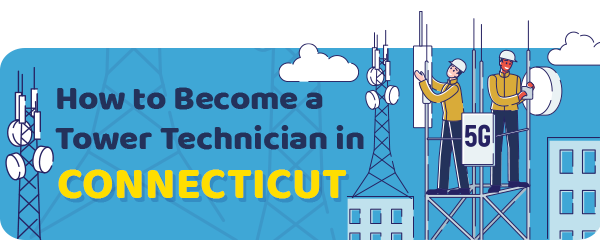
Cell tower technicians play an essential role within the telecommunications industry.
They install, repair, and maintain communications towers and related equipment.
Their daily job functions in Connecticut include climbing 200-foot-tall or higher towers with heavy gear, identifying and troubleshooting issues, fixing problems, and ensuring the towers are functioning correctly so that the digital world can continue operating.
Tower technicians work with various types of equipment and tools, including safety gear, testing devices, and power tools.
Keep reading if you’re interested in a career as a cell tower technician in Connecticut!
On This Page
Steps to Become a Cell Tower Technician in Connecticut
Follow these practical steps to become a cell tower technician in Connecticut:
Step One: Earn a High School Diploma
No training program will accept you, and no employer will hire you without a minimum of a high school diploma.
Although there is an apprenticeship path instead of an educational path to learn the basics, having a high school diploma provides the general knowledge necessary to be successful in the field.
For those who are still in high school and want to pursue a career as a cell tower technician, focus on foundational courses in physics, electronics, mechanics, and math, all of which come in handy on the job.
Also, develop your attention to detail and physical fitness where possible.
Step Two: Enroll in a Training Program
The most effective programs combine online or classroom conceptual learning with hands-on training and experience to make you a more well-rounded student.
When looking at different schools, find those that provide RF awareness, rigging, and safety training, and end with certifications in these areas.
The most common curricula cover climbing and rescue, fall protection systems, fiber optics, ground and electrical systems, and wireless network technology.
Step Three: Earn Basic Industry Certifications
Some employers require the following certifications, while others allow apprentices to earn them as they work.
- CPR and First Aid
- NATE Tower Climber Certification
- OSHA 10 or 30 Hour Safety
- RF Awareness and Rescue
These basic industry certifications have a heavy focus on safety.
During many training programs, you will learn the pertinent information and earn a certificate upon graduation.
Programs with this knowledge intertwined into the curriculum are the best option, so that you do not have to pursue the certificates post-graduation.
Step Four: Gain Hands-On Experience
Training programs offer hands-on experience, which is a topic you must discuss in interviews, as it helps you learn the basics for entry-level work.
Once you’re on the job, most employers will provide additional firsthand training with experienced cell tower technicians.
From these professionals, you will learn site management, rigging, and tower assembly through observation and application of knowledge.
Step Five: Advance Your Career
Once you have gained experience and the required certifications, you can advance your career by moving into leadership positions.
Lead climber, foreman, and project manager are all more managerial roles where you advise or lead a team to successfully install, repair, or maintain different towers around Connecticut.
Another option is to transition into fiber optics or wireless network engineering.
There are specialized certificates for these fields, which will help you more easily make the transition.
Licensing Requirement to Become
Like most other states, Connecticut doesn’t require licensure to become a cell tower technician.
Instead, many employers require basic certification, specifically related to safety.
The aforementioned certifications include:
- CPR and First Aid – crucial for all tower technicians to be CPR and First Aid certified in the event of a medical emergency.
- NATE Tower Climber Certification – this certification confirms that the technician knows the basics of climbing and related safety.
- OSHA 10 or 30 Hour Safety – the 10-hour OSHA safety certificate verifies that the candidate understands basic workplace safety. The 30 hours cover more detailed workplace safety protocols and measures. This is typically reserved for climbers with more experience.
- RF Awareness and Rescue – The RF Awareness and Rescue is related to radio frequency safety risks and how to rescue a fellow coworker if a related emergency occurs.
Cell Tower Technician Programs in Connecticut

BTS Training
For residents in the eastern part of the state, BTS Training has a location in East Providence, Rhode Island.
The school offers different types of tower training options, like Safety / Energy / Power training, Fiber Optics Training, and Outside Plant training.
Each of these highly emphasizes safety while covering the basics of designing, repairing, installing, and troubleshooting different types of systems.

NATE Tower Climber Training Exchange
NATE offers a national online climber training program with a comprehensive curriculum that covers OSHA certifications, fall protection, and rescue training.
These are the most desirable certifications and trainings that hiring managers seek.
New York Safety and Training
Depending on where you live in Connecticut, traveling to Brooklyn’s New York Safety and Training Center may be worthwhile.
The school offers OSHA-10 and OSHA-30-hour safety courses that cover basic and more detailed workplace safety.
Finishing the courses results in the OSHA 10 or OSHA 30 certification.
The school also offers other tower-related safety courses like equipment safety training and Fall Protection and Rescue.

PCI Training
The Pinnacle Career Institute (PCI) has a hybrid cell tower training program that covers online classroom knowledge mixed with a 10-day climber boot camp in Kansas City.
In the classroom, students like basic safety and technical topics that will be utilized on the job.
The bootcamp is a hands-on experience that focuses on tower climbing, rigging, equipment installation, and safety.
The entire program costs $5,000, including tuition, books, materials, and flight, room, board, and food at the Kansas City bootcamp.
| School Name | Address |
|---|---|
| NATE | 8 Second Street SE Watertown, SD 57201 |
| Pinnacle Career Institute | 11500 N.W. Ambassador Dr., Suite 221, Kansas City, MO 64153-1151 |
| BTS Training | 21800 Oxnard Street Suite 460 Woodland Hills, CA 91367 |
| New York Safety and Training | 132 32nd Street, Suite 121 Brooklyn, NY 11232 |
Salary
The median U.S. salary for a cell tower technician is $73,700.
Those in the lowest 10th percentile earn $59,364, and those in the highest 90th percentile make $89,900 per year.
Compared to the median salary in Connecticut, it is $78,800.
The lowest 10th percentile makes $63,500 while the highest 90th percentile earns $96,100.
Annual Salary Range:| Location | Avg. Annual Salary |
|---|---|
| Bridgeport | $63,435 |
| Stamford | $70,168 |
| New Haven | $66,360 |
| Hartford | $57,033 |
| Waterbury | $61,190 |
| Norwalk | $65,316 |
| Danbury | $63,423 |
| New Britain | $61,564 |
| West Hartford | $61,793 |
| Greenwich | $68,776 |
Salary by Metro Area in Connecticut
| Metro Area | Employed | Avg. Annual | Avg. Hourly | Top 10% | Bottom 10% |
|---|---|---|---|---|---|
| Hartford-West Hartford-East Hartford, CT | ** | $87,950 | $42.28 | $98,250 | $62,610 |
* Employment conditions in your area may vary.
Frequently Asked Questions
What are the most common places a tower technician works in Connecticut?
Although Connecticut is a small state, there are plenty of landscapes.
For those who want a more urban environment, Hartford or New Haven and the southern shore of the state are a great option.
For a more tranquil experience, the northern part of the state is more rural.
As a result, tower technicians can work in these areas for telecommunications companies, tower construction companies, or wireless service providers.
Also, they can be self-employed or work for government agencies.
It’s important to note that while you may start in one area, tower technicians travel extensively, so you likely won’t be stationed in the same place.
What are the typical training and certification durations at Connecticut schools?
To start working, those who take the educational path will earn a certificate, which takes between three and six months to complete, and results in entry-level technician work.
An advanced certification beyond the initial short-term certificate takes between six months and one year.
The result is a safety trainer role or equivalent.
An apprenticeship takes approximately one to two years, and apprentices gain extensive hands-on experience by climbing towers, conducting installations and repairs, and learning the basics of the field.
One of the main benefits of the apprenticeship path is that the worker is paid while gaining experience.
What are the key traits for success as a cell tower technician in Connecticut?
Given that you will be working at extreme heights in various weather conditions, you must be completely comfortable with heights.
Also, climbing the pole with equipment and tools requires strong physical fitness, and walking on narrow bars at the top demands excellent balance.
Other traits of successful technicians include detailed knowledge and attention to all safety protocols, a technical understanding of RF and electronics systems, the ability to problem solve under intense pressure, and a willingness to travel extensively.
Read the full guide: How to Become a Cell Tower Technician
 Cell Tower Technician by State